

Building a Professional Trading Workflow
A professional trading workflow is a repeatable operating loop: prepare, plan scenarios, qualify decisions, execute within risk, reconcile what happened and review the evidence. Each phase should reduce improvisation and expose what can be improved.
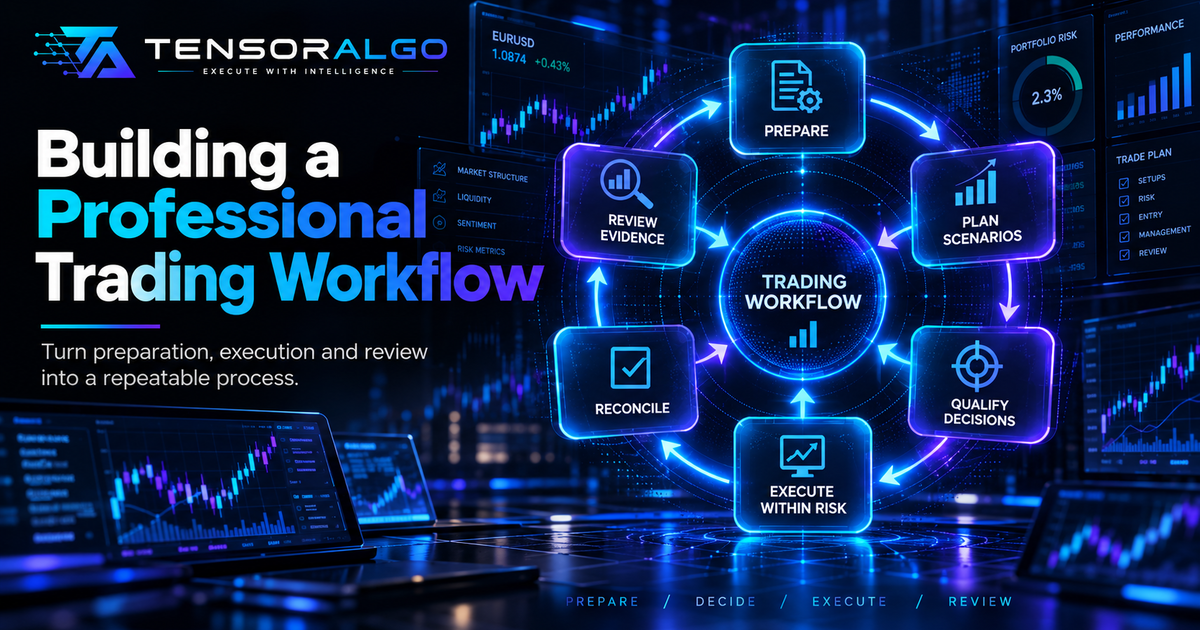
Building a Professional Trading Workflow: From Preparation to Review
A professional trading workflow is a repeatable operating process. It separates preparation, decision-making, execution, risk, and review so that each can be improved independently.
Educational information only. Futures involve substantial risk and leverage.
Phase 1: pre-session preparation
Before the active session:
- verify platform/data health;
- confirm the correct futures contract;
- review scheduled events;
- identify important reference levels;
- classify current market context;
- select permitted playbooks;
- define session risk limits.
Preparation should reduce decisions during fast conditions, not create a prediction that must be defended.
Phase 2: scenario planning
Write a small number of conditional scenarios:
If the market reaches a defined area and the required context remains valid and the trigger occurs, then the setup becomes actionable.
Also define what invalidates the scenario. “No trade” is a legitimate planned outcome.
Phase 3: opportunity qualification
Separate context from trigger. A level alone is not necessarily a trade. Check:
- location;
- regime;
- session;
- liquidity/volatility;
- required confirmations;
- event restrictions;
- risk capacity.
This prevents urgency from replacing process.
Phase 4: execution
Before entry, the order plan should already contain:
- trigger;
- order type;
- quantity;
- stop/invalidation;
- intended management;
- maximum planned risk.
During execution, prioritize state accuracy. If the order or position state is uncertain, reconcile before adding exposure.
Phase 5: in-trade management
Management rules should be written before the outcome is known. Define whether partials, trailing, scratch rules, or time-based exits are allowed.
Do not transform a scalp into an investment because the stop is uncomfortable.
Phase 6: post-trade capture
Record the setup, context, fills, planned/realized risk, MFE/MAE, adherence, and any technical issue.
A quick decision-time screenshot can be more valuable than a polished chart created after the move.
Phase 7: end-of-session review
Reconcile orders and positions first. Then ask:
- Did I follow the playbook?
- Did risk remain within limits?
- Were losses normal strategy outcomes or mistakes?
- Were there data/execution problems?
- Is anything worth investigating later?
Avoid strategy redesign while reacting emotionally to one session.
Weekly research cycle
Aggregate results by playbook, session, regime, and adherence. Review enough evidence before changing rules.
When a change is justified, version it and preserve the previous version's results.
Separate production from research
New ideas should not silently modify live decision logic. Test hypotheses historically and/or in shadow/forward mode, define promotion criteria, and keep rollback available.
This separation is especially important for adaptive or AI-assisted systems.
Operational checklist
A professional workflow also covers:
- software updates;
- data entitlements;
- backups;
- credential security;
- broker connectivity;
- contract rollover;
- time-zone/session configuration;
- notification health;
- automation kill switches.
Operational mistakes can overwhelm a good market decision.
Reduce cognitive load
Use named playbooks, standard fields, checklists, alerts, and default layouts. The purpose is not bureaucracy; it is to preserve attention for decisions that genuinely require judgment.
The Workflow as a Closed Loop
A useful operating model is prepare → observe → qualify → execute → reconcile → review → research → update. Research changes return to preparation only after validation. Keeping the loop explicit prevents a new idea discovered mid-session from silently becoming a live rule.
Workspace Design
Arrange information by decision priority rather than visual novelty. Critical state—instrument, position, risk, active playbook and data health—should be easy to see. Secondary analytics can support context without competing for attention.
Pre-Session Data and Contract Check
Confirm the correct contract month, session/time zone, feed health and scheduled events. Futures liquidity migrates between contracts, and an incorrect rollover or time-zone setting can invalidate otherwise correct analysis.
Scenario Sheet
Write two or three conditional scenarios with explicit invalidation. Example: if price reaches a reference area and the defined reclaim occurs while the event filter is clear, Playbook A becomes eligible; if acceptance occurs through the level, the scenario is cancelled. This is planning, not forecasting.
Risk Gate
Before any entry, calculate position size, remaining daily capacity and combined open exposure. The Risk Management Guide and Position Sizing Guide provide the formulas. Risk checks should be completed before urgency enters the decision.
Execution and Reconciliation
Record order intent separately from confirmed fills. After a disconnect or ambiguous order response, reconcile the actual position before doing anything else. This is equally important in manual and automated workflows.
End-of-Day Operations
Close or verify any exposure that should not remain, confirm trade records, note technical incidents and preserve screenshots. Operational cleanup prevents yesterday's stale state from contaminating tomorrow's session.
Weekly Strategy Review
Aggregate by Playbook/version, session, regime and adherence. Review expectancy, costs, MFE/MAE and drawdown, but do not alter rules merely because the latest week was negative. Promote changes through research and forward testing.
Information Security
Use MFA, least-privilege credentials, backups and a documented emergency path to the broker where applicable. Keep trading credentials out of browser/client code and periodically review third-party access.
Authoritative Market Education
The CFTC Learn & Protect center and CME Education provide primary educational material on derivatives mechanics and risk. Use exchange/regulator sources when a workflow depends on changing product specifications.
TensorAlgo Workspace
TensorAlgo's current product design centers the workflow on user-defined Playbooks, live market context and review. Its Support Center documents current behavior, while specialized broker/execution software can remain a separate layer.
Opening Routine
Use the same sequence each day: system health, calendar, active contract, overnight structure, key references, risk capacity and eligible playbooks. Consistency reduces omissions.
Market Context Sheet
Record trend/balance, volatility, important levels and event windows without turning them into a forced directional forecast. Context should narrow which playbooks are eligible.
Alert Design
Alerts should correspond to a decision: level approached, setup armed, trade entered, risk event or system failure. Alerts that do not change behavior become noise.
Focus Management
Limit active charts and markets to what can be monitored reliably. More screens can increase information while reducing attention. Measure missed signals and execution errors as the workspace grows.
Break Protocol
Define when you step away and how positions/alerts are handled. Fatigue is an operational variable; a workflow should not require continuous attention beyond what the trader can sustain.
Post-Loss Protocol
After a loss, verify whether it was compliant, whether risk remains and whether the next setup is independently valid. Do not make the next trade responsible for recovering the previous one.
Post-Win Protocol
A large winner can also change behavior. Keep size and eligibility rules unchanged unless the predefined risk framework says otherwise.
Research Inbox
Capture new ideas during the session in a separate queue rather than implementing them immediately. Review later when outcomes are no longer moving in front of you.
Weekly Maintenance
Check software updates, data subscriptions, contract rollover, backups, credentials and alert delivery. Operational maintenance belongs on the calendar just like strategy review.
Metrics Dashboard
Track process metrics such as adherence, valid setups missed, invalid trades taken, slippage and incidents alongside P&L. Process metrics often identify problems earlier.
Business Continuity
Know how to contact the broker or verify positions if the primary platform fails. Keep critical account recovery information secure and accessible.
Workflow Documentation
Write the complete workflow so another competent person could understand the sequence. Documentation exposes hidden assumptions and makes later automation safer.
A Practical Workflow Blueprint
A workflow becomes more useful when every phase has an input, decision, output, and failure check. Before the session, inputs include the active contract, event calendar, market context, platform health and remaining risk capacity. The output is not a directional prediction; it is a small set of conditional scenarios and a list of playbooks that are actually eligible.
During the session, separate observation from authorization. Price reaching a level is an observation. A playbook becoming eligible is a rules decision. Sending an order is another decision. Keeping those states separate makes mistakes easier to diagnose and later automation safer.
A compact operating sequence is:
| Phase | Primary question | Evidence to preserve | | --- | --- | --- | | Prepare | Is the environment ready? | contract, calendar, data health, risk budget | | Plan | What conditions would matter? | scenarios, levels, invalidations | | Qualify | Is a named playbook actually eligible? | context, trigger, vetoes | | Execute | What order expresses the plan? | intent, quantity, stop, fills | | Reconcile | What is the real position state? | broker/exchange confirmations | | Review | Did process and outcome diverge? | journal, MFE/MAE, adherence, incidents | | Research | Is a rule change justified? | sample, hypothesis, test, version |
This structure connects naturally with a trading playbook: the workflow governs when decisions happen, while the playbook defines what conditions make a specific setup valid.
Failure Modes a Professional Workflow Should Catch
A workflow is most valuable on abnormal days. Common failure modes include the wrong contract month, stale market data, a time-zone mismatch, an unacknowledged order, duplicate alerts, a position that differs from local state, or an event window that invalidates normal assumptions. The response should be predefined: stop adding exposure, establish authoritative state, then decide whether trading can safely resume.
That operational discipline is consistent with exchange-level risk thinking. CME Group documents pre-trade controls such as exposure limits, position limits, order blocking and cancellation, while its Globex risk tools include kill-switch functionality. Those institutional controls are not a template for a retail setup, but they illustrate the same principle: risk control belongs in the system, not only in the trader's intention.
For strategy changes, route new ideas through the Backtesting Guide and then the Forward Testing Guide rather than changing production rules mid-session. For behavioral errors, the Decision Fatigue guide is a useful companion because process design should reduce unnecessary choices before they become execution mistakes.
What to Measure Beyond P&L
A professional review should include outcome metrics and process metrics. Useful process measures include valid setups missed, invalid trades taken, rule adherence, average slippage, order-state incidents, alert failures, and the percentage of trades whose decision-time evidence was captured correctly. A flat P&L period with improving process quality is different from a flat period caused by random execution.
The Trading Journal Guide explains how to preserve those observations so weekly review is based on contemporaneous evidence rather than memory.
Source Notes
For changing futures mechanics, use primary sources. CME Group's pre-trade risk-management documentation describes exchange-side controls, and CFTC Learn & Protect provides derivatives risk education. Product specifications, margin requirements and broker procedures should always be checked against their current official documentation.
Example Daily Operating Rhythm
A workflow can be time-boxed without becoming rigid. Before the active session, reserve a short block for system health, contract/session verification, event risk, market context and scenario planning. During the session, only update information that can change eligibility or risk. After the session, reconcile state before interpretation: positions and orders first, journal second, research ideas last.
This ordering matters. If review begins before reconciliation, a technical position mismatch can be mistaken for a strategy outcome. If research begins while emotions from the latest trade are still dominant, a normal loss can become an unnecessary rule change.
Change-control rule
Every proposed change should identify the observed problem, evidence supporting the change, expected mechanism, validation method and rollback condition. Cosmetic preferences do not need the same process as risk or strategy changes, but anything that changes eligibility, sizing, execution or management should be versioned.
Continuity rule
Assume a dependency will eventually fail. Know how to verify positions if the primary platform is unavailable, how to identify stale data, and how to stop new actions when authoritative state is unclear. Keep recovery procedures simple enough to follow under pressure.
The result is not a workflow with more bureaucracy. It is a workflow in which important transitions are explicit: preparation becomes a plan, a plan becomes an eligible setup, an eligible setup becomes an order only after risk approval, and an outcome becomes a strategy change only after review and validation.
Minimum Viable Documentation
A professional workflow should be documented well enough that future-you can reconstruct it after a month away. Record session boundaries, market universe, playbook versions, risk limits, data dependencies, alert meanings, order/reconciliation procedure, journal fields and the process for approving changes.
Documentation also exposes hidden assumptions. If a step cannot be written clearly—such as how the active contract is chosen or when an alert becomes actionable—it is probably relying on memory or improvisation.
Keep the document operational rather than aspirational. Trade with discipline is not a procedure; a predefined response to repeated process violations is. The goal is to make important behavior reproducible without pretending every market decision can be automated.
Workflow Audit Question
Once a month, walk through the process as if the primary platform, data feed or alert channel were unavailable. Identify which decisions would become unsafe and which fallback is authoritative. This simple audit often reveals hidden dependencies before they become live incidents and keeps continuity planning tied to the real workflow.
Keep the Loop Small Enough to Use
A workflow fails if it is too complicated to follow during real conditions. Automate repetitive capture where reliable, keep checklists short, and reserve manual attention for consequential decisions. Review skipped steps as design feedback: the process may need simplification rather than another reminder.
Frequently Asked Questions
What are the core parts of a professional trading workflow?
A practical loop is preparation, scenario planning, opportunity qualification, execution within risk, reconciliation, journaling and periodic review.
How much pre-session preparation is enough?
Enough to define the relevant market context, scenarios, risk limits and event constraints without creating a checklist so large that it is ignored during the session.
What parts of the workflow should be automated?
Automate stable, repetitive tasks such as data capture, alerts and reconciliation where appropriate, while keeping strategy changes and consequential risk decisions inside explicit controls.
How should the workflow be improved over time?
Review repeated failures and bottlenecks in batches, change one defined part at a time, version material changes and then collect new evidence.
Final Takeaway
A professional workflow is a closed operating loop: prepare, plan, qualify, execute, reconcile and review. Its value comes from reducing improvisation, preserving evidence and making each change deliberate enough to evaluate.