

Position Sizing Calculator Guide
Turn entry, invalidation, tick value, fees, slippage and a defined risk budget into an appropriate futures contract quantity. Includes formulas, worked examples and a reusable position-sizing framework.
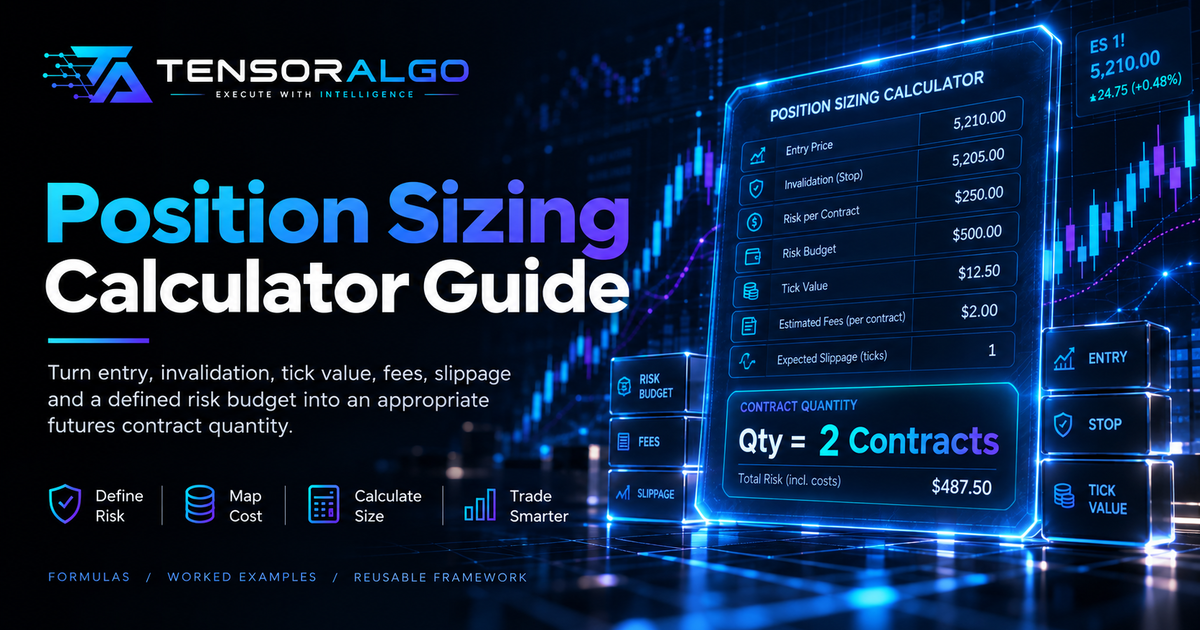
Futures Position Sizing Calculator Guide: How Many Contracts Should You Trade?
Position sizing converts a trading idea into a specific amount of exposure. The calculation answers one practical question:
Given my entry, invalidation, contract specifications, and maximum planned risk, how many futures contracts fit?
That question should be answered before the order is sent.
CME's position-sizing education emphasizes two inputs: where the stop belongs and how much capital the trader is prepared to risk. CME's broader position and risk management guide also warns traders not to simply trade the maximum number of contracts their broker permits based on margin.
This guide turns those principles into a reusable futures position-sizing process.
Educational information only. Futures involve substantial risk and leverage. Examples are hypothetical, not recommendations. Verify current contract specifications with the relevant exchange and broker.
The Futures Position Sizing Formula
The calculation has four steps.
1. Calculate stop distance in ticks
If entry and stop are quoted in price:
stop distance in ticks \= absolute(entry price − stop price) ÷ minimum tick size
2. Calculate stop risk per contract
stop risk per contract \= stop distance in ticks × tick value
3. Add realistic costs
estimated risk per contract \= stop risk + estimated commissions/fees + slippage allowance
4. Calculate quantity
maximum contracts \= floor(allowed trade risk ÷ estimated risk per contract)
The floor function matters. If the result is 2.8 contracts and the risk ceiling is hard, the maximum is two, not three.
Position Size Starts With Invalidation
The formula is simple. Choosing a valid stop is the difficult part.
Do not begin with:
“I want five contracts. Where can I put the stop?”
Begin with:
“What market condition makes this setup invalid?”
Then calculate what one contract risks at that invalidation.
If the result is too large, there are three clean choices:
- use a smaller contract variant where available;
- wait for a different setup whose valid risk fits;
- skip the trade.
Moving a stop inside normal market structure purely to increase quantity changes the strategy.
For the broader framework around invalidation, daily limits, drawdown, and correlated exposure, read our Futures Risk Management Guide.
Worked Example 1: Generic Futures Contract
Assume:
- allowed planned risk: $250;
- stop distance: 18 ticks;
- tick value: $5;
- estimated fees/slippage: $10 per contract.
Stop risk:
18 × $5 \= $90
Estimated risk per contract:
$90 + $10 \= $100
Position size:
floor($250 ÷ $100) \= 2 contracts
Estimated planned risk at two contracts:
2 × $100 \= $200
Three contracts would estimate $300, which exceeds the $250 rule.
The unused $50 is not a problem. Position sizing is designed to stay below a risk ceiling, not to consume every available dollar.
Worked Example 2: Converting Points to Ticks
Suppose a hypothetical contract has:
- minimum tick size: 0.25 points;
- tick value: $2.50;
- entry: 18,000;
- invalidation: 17,995;
- risk budget: $125;
- estimated costs/slippage: $5 per contract.
Price distance:
18,000 − 17,995 \= 5 points
Ticks:
5 ÷ 0.25 \= 20 ticks
Stop risk per contract:
20 × $2.50 \= $50
Estimated risk per contract:
$50 + $5 \= $55
Maximum quantity:
floor($125 ÷ $55) \= 2 contracts
Estimated planned risk:
2 × $55 \= $110
This is intentionally generic. Do not infer any real contract's current specifications from it.
Why Contract Specifications Matter
Futures products have different multipliers, tick sizes, settlement rules, and margin requirements. Exchanges can update specifications and brokers can impose additional requirements.
Use the exchange's current contract page or your broker's current specification.
If you are still learning terms such as tick, multiplier, margin, notional value, and rollover, our Futures Trading Glossary provides a reference, while What Is Futures Trading? explains the contract structure from the beginning.
Fixed-Dollar Risk
A fixed-dollar method sets the same planned risk budget until the trading plan deliberately changes it.
Example:
allowed risk \= $150 per trade
Advantages include simplicity, auditability, and stable dollar exposure. The limitation is that $150 represents a different percentage of the account as equity changes.
Percentage-Based Risk
A percentage method calculates:
allowed risk \= defined risk base × chosen risk percentage
For example, if the defined risk base were $20,000 and the strategy rule were 0.5%:
$20,000 × 0.005 \= $100
This is arithmetic, not a recommended risk percentage.
Percentage sizing scales exposure as the risk base changes. But the risk base must be meaningful. A nominal “$50,000” evaluation account does not necessarily provide $50,000 of usable loss capacity if a much smaller trailing threshold is the binding constraint.
Margin Is Not Position Sizing
Futures margin determines how much capital must be available to support a position. It does not define a sensible loss for the trade.
CME explains futures margin as a performance-bond mechanism rather than a down payment on the underlying asset, and requirements can change with market conditions.
This creates an important distinction:
Broker maximum: what the account is permitted to hold.
Strategy size: what fits the predefined risk budget.
Never substitute the first for the second.
Notional Exposure vs Planned Stop Risk
Position sizing based on a stop controls one scenario: the estimated loss if the position exits near the planned invalidation.
It does not erase notional exposure.
A futures contract can represent substantial underlying exposure relative to the margin posted. In an extreme gap, fast market, or operational failure, realized loss can exceed the planned stop loss. The CFTC's futures education notes that leveraged futures losses can exceed the amount initially invested.
That is why a complete risk framework also limits total quantity and aggregate exposure.
Adding Fees and Slippage
A calculator that ignores trading costs systematically understates risk.
For each contract, estimate:
- commission;
- exchange/clearing/broker fees where applicable;
- expected spread cost;
- stop slippage;
- additional event/liquidity allowance if the strategy permits those conditions.
For frequent short-duration strategies, even modest round-trip costs can materially change net expectancy across a large sample.
Keep planned stop risk and estimated total trade risk as separate fields so assumptions can later be compared with actual fills.
Planned Risk vs Realized Risk
After the trade:
risk error \= realized loss − estimated planned loss
Repeated positive risk error can reveal:
- underestimated slippage;
- late exits;
- stop movement;
- order-routing issues;
- partial-fill behavior;
- fees omitted from the model.
Position sizing improves when this feedback is incorporated rather than assuming perfect fills.
Smaller Contract Variants
Where exchanges list smaller versions of a contract, they can improve sizing granularity.
Suppose the larger contract risks $240 at the valid stop but the account rule permits only $150. If a smaller variant represents a fraction of the exposure, it may allow the setup to fit without distorting the stop.
Smaller does not automatically mean safer. Trading many smaller contracts can recreate or exceed the larger contract's exposure.
What If the Calculator Returns Zero?
Zero is a valid output.
It means:
under the supplied invalidation, contract economics, costs, and risk limit, even one contract does not fit.
Do not “fix” zero by:
- rounding up;
- ignoring costs;
- moving the stop closer without strategy justification;
- increasing the risk limit impulsively.
A calculator is valuable partly because it can tell you not to trade.
Volatility-Based Stops and Sizing
Some strategies use volatility measures such as ATR to help define stop distance.
For example:
stop distance \= k × ATR
where k is a strategy parameter.
Position size then adjusts inversely: when volatility expands and the valid stop becomes wider, fewer contracts may fit the same dollar risk.
This can stabilize account-level risk, but ATR is not a universal stop-placement method. The strategy still needs evidence that the chosen volatility rule corresponds to meaningful invalidation.
Structure-Based Stops
Other strategies use market structure:
- swing high/low;
- failed breakout;
- VWAP acceptance/rejection;
- previous-day level;
- volume-profile reference;
- opening-range or Initial Balance structure.
The calculator does not decide which structure is valid. It translates the chosen invalidation into exposure.
This separation is important:
analysis determines invalidation; sizing determines quantity.
Scaling Into a Position
Scaling in requires budgeting for the complete planned position, not just the first entry.
Suppose the maximum allowed trade risk is 1R and the playbook permits three entries. A hypothetical allocation could be:
- entry 1: 0.3R;
- entry 2: 0.3R;
- entry 3: 0.4R.
The exact allocation is strategy-specific. What matters is that later tranches cannot silently push total planned risk beyond the predefined limit.
Recalculate if the stop or average entry changes.
Scaling Out
Partial exits reduce open quantity and therefore change remaining exposure.
Track:
- initial risk;
- quantity removed;
- realized P&L;
- new stop if changed;
- remaining open risk.
Do not retroactively redefine the original trade as “low risk” because an early partial happened to succeed.
Multiple Positions and Correlation
A calculator that sizes each ticket independently can still create too much portfolio risk.
Suppose two positions each risk $150 but are exposed to the same market factor. A common shock could make the practical combined risk closer to $300 than two independent $150 bets.
After sizing each position, perform a second check:
combined open risk \= sum of planned open risks under a defined adverse scenario
You can also impose caps by asset family or directional theme.
Position Sizing Around Scheduled Events
Scheduled macro releases can change volatility and slippage abruptly.
A strategy can:
- prohibit entries;
- reduce size;
- widen slippage assumptions;
- use a separate event playbook;
- trade normally if validated for that condition.
The calculator should use the assumptions of the applicable playbook rather than pretending execution conditions are constant.
Position Sizing for Prop Evaluations
Prop-style evaluation rules introduce constraints that a standard percentage-of-equity calculator may miss.
Depending on the provider, relevant rules can include trailing drawdown, static maximum loss, daily loss, consistency requirements, maximum contract quantity, and minimum trading days.
These rules vary and change, so verify current terms directly.
If the remaining loss threshold is $1,000, treating a headline “$50,000 account” as a normal $50,000 risk base can be misleading.
Our Prop Trading Explained guide covers these mechanics in more detail.
A Position Sizing Calculator Template
A practical calculator can use these inputs:
Instrument: Contract month: Minimum tick: Tick value: Entry price: Stop/invalidation price: Stop distance in ticks: Risk base: Allowed risk: Estimated fees per contract: Slippage allowance per contract: Current open/correlated risk:
Then calculate:
- raw stop risk per contract;
- estimated all-in risk per contract;
- maximum whole contracts;
- total planned risk;
- remaining session risk.
Store the inputs with the trade so the calculation can be audited later.
Spreadsheet Formula
If a spreadsheet uses B2 for allowed risk, B3 for stop distance in ticks, B4 for tick value, and B5 for estimated costs per contract:
Risk per contract:
B3 × B4 + B5
Maximum contracts:
ROUNDDOWN(B2 ÷ (B3 × B4 + B5), 0)
Use input validation so tick values and stop distances cannot accidentally be blank or negative.
Position Sizing for Automated Trading
Automation should calculate size from authoritative inputs and then apply hard independent limits.
Useful guards include:
- maximum contracts;
- maximum dollar risk;
- permitted instrument;
- data freshness;
- current position reconciliation;
- remaining daily loss capacity;
- duplicate-order protection.
An AI confidence score should not bypass deterministic quantity limits.
For the larger execution architecture, see Trading Automation Explained.
Common Position Sizing Mistakes
Choosing quantity first
This makes dollar risk depend on whatever stop is selected afterward.
Using buying power as the size rule
Margin capacity is not a risk budget.
Rounding up
If the calculation says 2.4 contracts under a hard limit, three exceeds the modeled risk.
Ignoring slippage
Stops do not guarantee the trigger price.
Tightening the stop to trade bigger
This changes the strategy and can put invalidation inside ordinary noise.
Using stale contract specifications
Verify the exact product and contract.
Forgetting correlation
Several individually valid positions can create one concentrated portfolio bet.
Increasing size after a winning streak
Recent wins do not make the next trade less uncertain.
Martingale sizing
Increasing exposure simply because prior trades lost can cause risk to grow during the exact sequence the account needs to survive.
How TensorAlgo Fits Into Position Sizing
TensorAlgo can help structure the setup around the sizing calculation: market context, playbook, trigger, invalidation, risk, management, and review.
The sizing formula itself should remain transparent. A trader should be able to explain why the stop is where it is and exactly how the contract quantity was calculated.
The first TensorAlgo Playbook guide shows how to formalize those rules. You can also browse the Playbooks Marketplace to explore strategies created by other users.
Position Sizing in One Sentence
Let the market define the invalidation, let the risk plan define the dollars, and let the calculator define the number of contracts.
That order prevents the desire for size from changing the trade.
Ready to formalize the entire process? Create your first TensorAlgo Playbook and define context, entry, invalidation, risk, management, and review before execution.
Position Size Is Constrained by More Than the Formula
The arithmetic produces a maximum whole-contract quantity, but the final decision can be smaller because of daily loss limits, correlated positions, event risk, liquidity or a strategy-specific cap. Treat the formula as a ceiling under stated assumptions, not an instruction to use the largest possible size.
The Risk Management Guide explains portfolio/session constraints, while Best Futures Markets shows why contract granularity and liquidity differ across market families.
Recalculate When the Stop Changes
If the invalidation distance changes, risk per contract changes. Increasing the stop while leaving quantity unchanged silently increases monetary risk. Conversely, forcing the same narrow stop onto every market just to preserve size can disconnect the stop from the setup's actual invalidation.
A clean sequence is: define invalidation → measure distance → convert to ticks/points → calculate risk per contract → include expected costs → calculate whole-contract quantity → apply portfolio/session caps.
Margin Is Not Position Risk
CME Group's education material distinguishes margin requirements from trader-defined risk. Margin is part of the clearing/broker framework; it is not the maximum amount a futures position can lose. A stop also does not guarantee the planned fill price during fast or illiquid conditions.
The What Is Futures Trading? guide covers leverage and margin mechanics, and the Futures Trading Glossary provides the definitions behind the sizing formula.
Validate Contract Specifications
Tick size, tick value, contract multiplier and settlement rules are contract-specific. Verify current specifications with the exchange and current margin policies with the broker. For CME-listed products, CME Education and the relevant product pages are appropriate primary sources.
Sizing in a Journal and Backtest
Store the inputs used for each size decision, not just the final quantity. That makes it possible to determine whether a large loss came from normal slippage, an unusually wide stop, a sizing error or a rule violation. The Trading Journal Guide provides a field structure, while the Backtesting Guide explains why historical tests should use the same sizing logic intended for live evaluation.
Frequently Asked Questions
How do I calculate futures position size?
Define the allowed trade risk, calculate the stop distance in ticks, multiply by tick value, add realistic per-contract costs, then divide allowed risk by estimated per-contract risk and round down.
How many futures contracts should I trade?
There is no universal number. Quantity depends on the exact contract, stop distance, risk budget, costs, existing exposure, and account constraints.
Should I use a fixed number of contracts every trade?
You can, but dollar risk will vary as stop distance changes. Risk-based sizing adjusts quantity to control that variation.
Should I include commissions in position sizing?
Yes when they are meaningful to the strategy. Frequent short-duration trading can make transaction costs particularly important.
Is margin the same as the amount I risk?
No. Margin supports the position; it does not cap the potential loss.
Can my realized loss exceed the calculator estimate?
Yes. Slippage, gaps, connectivity problems, and other execution events can produce losses beyond the planned estimate.
What if one contract is too large?
Where available, a smaller contract variant may provide more granular exposure. Otherwise the trade may not fit the chosen risk limit.
Should I size from account balance in a prop evaluation?
Not automatically. Use the actual constraints of the program, including any binding loss or trailing threshold, and verify current rules directly.