

Forward Testing Guide
Forward testing moves a frozen strategy from historical research into live-arriving data without jumping straight to full production risk. It tests signal parity, execution assumptions, operations and predefined promotion or rollback criteria.
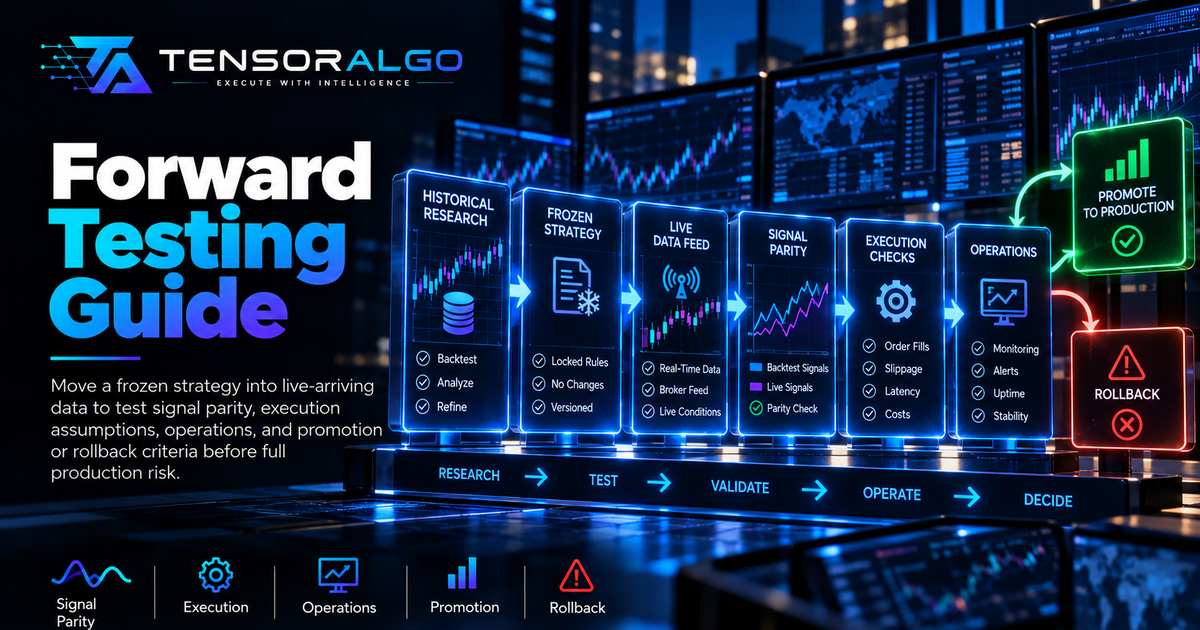
Forward Testing Guide: Validate a Trading Strategy on Live-Arriving Data
Forward testing evaluates a fixed strategy using data that arrives after the rules are established. It is the bridge between historical research and meaningful production confidence.
Educational information only. Forward results do not guarantee future performance.
Why forward testing matters
Historical tests can accidentally benefit from hindsight, optimized parameters, clean data, or unrealistic execution. Forward testing exposes the strategy to current data and operational conditions without allowing future information into the decision.
It also reveals whether the implementation matches the research.
Freeze a version
Give the strategy a version and record:
- rules;
- parameters;
- eligible markets/sessions;
- risk logic;
- expected signal frequency;
- data sources;
- execution assumptions.
If you change the logic, start a new version rather than silently mixing evidence.
Stage 1: live-data shadow mode
Run the strategy on live-arriving data without changing actual trading decisions. Record every eligible signal and the exact information available at that moment.
Shadow mode is ideal for finding data gaps, timestamp issues, state bugs, and unexpected signal frequency.
Stage 2: simulated execution
Add order simulation with realistic spread, fees, latency, and slippage assumptions. Confirm that state transitions and management rules behave as intended.
Simulation still differs from live execution, particularly around queue position and psychology.
Stage 3: limited production exposure
Where appropriate and only after prior gates pass, a strategy can be introduced with deliberately constrained risk. Promotion criteria and rollback conditions should be written before launch.
Do not increase exposure merely because the first few trades win.
Compare expected and observed behavior
Track:
- signal frequency;
- context/regime distribution;
- entry availability;
- slippage;
- commissions;
- MFE/MAE;
- expectancy;
- drawdown;
- rule adherence;
- technical failures.
A mismatch in signal frequency can indicate implementation drift even before P&L becomes informative.
Statistical patience
Forward samples accumulate slowly. Avoid repeatedly changing the strategy after every outcome; doing so prevents a clean test.
Define a minimum observation period or sample target, while recognizing that market-regime coverage also matters.
Operational evidence
Forward testing should capture issues historical tests cannot:
- stale/missing feeds;
- reconnects;
- out-of-order events;
- duplicate messages;
- clock/time-zone mistakes;
- contract rollover;
- broker rejects;
- partial fills;
- position mismatches.
Operational reliability is part of strategy viability.
Shadow learning versus live learning
A model can calculate candidate improvements in shadow mode without changing production decisions. That protects the live process while gathering evidence.
If self-learning is intended to influence live decisions, define a promotion mechanism: minimum evidence, comparison against baseline, guardrails, versioning, rollback, and post-promotion monitoring.
Without a promotion path, “learning” remains research only.
Use a control/baseline
Compare the candidate strategy or model against the existing process. Measure incremental effect rather than only absolute outcomes.
For filters, examine both trades accepted and trades rejected; otherwise you cannot tell whether filtering removed losses at the cost of larger missed opportunities.
When to stop a forward test
Predefine stop conditions such as:
- material rule/implementation bug;
- data-integrity failure;
- risk-control failure;
- behavior outside validated assumptions;
- sufficient evidence to reject the hypothesis.
Stopping because of a normal losing streak can bias research.
Promotion checklist
Before increasing influence:
- implementation matches specification;
- data is fresh/reliable;
- sample meets predefined criteria;
- costs are realistic;
- results are not concentrated in one regime;
- risk limits work;
- operational failure tests pass;
- rollback is available;
- monitoring/alerts are active.
Forward Testing Versus Paper Trading
Paper trading describes simulated execution. Forward testing describes the research design: frozen rules evaluated on future-arriving data. A forward test can use shadow signals, simulated orders or tightly controlled live exposure; what matters is that the observations were not available when the rules were selected.
Write the Acceptance Criteria First
Define minimum sample/period, allowed implementation error rate, cost assumptions, drawdown boundary, baseline comparison and required regime coverage before results arrive. Otherwise promotion criteria can drift toward whatever the candidate happens to produce.
Signal-Parity Testing
Compare research and production implementations on the same timestamps. If the historical engine says a signal existed but the live engine did not, investigate data versions, session logic, feature timing and state transitions before judging performance.
Shadow Mode
Shadow mode records what the candidate would have done without changing live decisions. Capture accepted and rejected opportunities, model/version, data timestamps and hypothetical outcome. Shadow systems need monitoring too; silently missing observations create survivorship bias.
Execution Simulation
Add realistic order rules, costs, latency and partial-fill assumptions. Compare simulated fills with observable market data. The objective is not perfect replication but discovering whether historical assumptions are materially optimistic.
Limited Promotion
If predefined gates pass, increase influence gradually. Keep deterministic risk controls and rollback independent of the candidate. Promotion is a software/research decision, not proof that future performance is known.
Baseline and Counterfactuals
Compare the candidate with the current process. For a filter, record what happened to rejected trades where feasible. Without counterfactual evidence, “avoided losses” can hide avoided winners.
Drift Monitoring
Track signal frequency, feature distributions, regime mix, calibration and execution quality. A sudden change can indicate market drift, data failure or code regression. Investigation should precede automatic retraining.
When to Restart the Test
A material change to entry, target, stop, feature set, model or risk logic creates a new version. Preserve old evidence but do not combine it indiscriminately with the new strategy's sample.
Forward-Test Report
Include version, start/end, signals, actual/simulated fills, costs, expectancy, drawdown, implementation discrepancies, incidents, regime distribution, baseline comparison and promotion decision. Link the result back to the original Backtesting Guide evidence.
TensorAlgo During Forward Testing
TensorAlgo can help keep a Playbook version, supported market context and trade-review evidence visible while a strategy is observed on live-arriving data. Promotion criteria, risk limits and rollback rules should be defined before results are known rather than inferred from a short favorable run. See the Support Center for current platform scope.
External Research Reference
Time-series evaluation must preserve chronology. The scikit-learn TimeSeriesSplit documentation provides a concrete implementation example of time-ordered cross-validation. For futures risk context, use the CFTC Learn & Protect resources.
Forward-Test Dataset
Store every candidate signal, including ones blocked by risk or filters, with timestamp and version. This prevents the forward dataset from containing only the trades that were convenient to observe.
Latency Measurement
Record when source data arrived, when the decision was computed and when an order would have been submitted. Historical systems often assume instantaneous calculation; forward testing exposes real latency.
Data Parity
Compare feature values between research and live pipelines for identical timestamps. Differences in session templates, rounding, provider data or indicator warm-up can explain performance gaps.
Expected Frequency
Historical research should estimate how often the setup appears. If a forward system suddenly produces twice as many signals, investigate implementation before waiting for P&L to reveal the bug.
Operational Error Budget
Track missing signals, duplicate signals, stale-data blocks and reconciliation failures. A candidate with attractive simulated expectancy but frequent infrastructure errors is not production-ready.
Promotion Decision
Write a short decision record: evidence reviewed, criteria passed/failed, known limitations, approved influence and rollback threshold. This prevents a vague 'looks good' from becoming the deployment standard.
Limited Exposure
When real exposure is appropriate, begin below the maximum validated risk and confirm execution behavior. Scaling should follow additional evidence, not a few favorable early outcomes.
Rollback
Keep the previous stable version deployable. Define whether rollback is triggered by strategy metrics, data integrity, execution incidents or all three. Operational failure can require rollback even when P&L is positive.
Forward-Test Contamination
Once you inspect results and alter the strategy, subsequent observations belong to a new version. Do not combine pre-change and post-change samples as though the rules were fixed.
Reporting
A useful report includes both strategy metrics and system metrics. Signal parity, feed health and execution discrepancies can explain outcomes that a P&L-only report cannot.
Designing a Forward Test That Can Actually Answer a Question
A useful forward test begins with a falsifiable question. Instead of “does this strategy work?”, define what should remain stable if the historical result generalizes: signal frequency, setup distribution, cost sensitivity, regime coverage, execution quality, or a specified performance range. Then decide what observation would make you investigate, pause or reject the candidate.
The test record should preserve the decision-time feature values, strategy/model version, market-data timestamps, eligible setup, hypothetical order intent, simulated or actual fill assumptions, and subsequent outcome. This is especially important for adaptive systems: if features or thresholds change while the sample is accumulating, the observations no longer describe one fixed candidate.
Historical, shadow, simulated and limited-live evidence
| Stage | New market data? | Simulated execution? | Capital at risk? | Main purpose | | --- | --- | --- | --- | --- | | Backtest | No | Yes | No | historical plausibility | | Shadow | Yes | optional | No | signal/data parity | | Paper/sim | Yes | Yes | No | execution/state behavior | | Limited live | Yes | No | Yes, constrained | real operational evidence |
The stages answer different questions. A clean backtest does not prove the live feature pipeline is correct; a clean shadow run does not prove fill assumptions; a handful of live trades does not establish statistical robustness.
The Machine Learning in Financial Markets guide is especially relevant when the candidate contains learned features or models, because temporal validation and production drift must be treated as part of the same evidence chain.
Use Gaps, Baselines and Counterfactuals Carefully
Time-ordered evaluation should preserve chronology. Scikit-learn's documentation demonstrates time-based cross-validation with a gap between training and test windows; the exact implementation for a trading system will differ, but the principle is useful: information from the evaluation period must not leak backward into selection or calibration.
A forward test also needs a baseline. If a new filter rejects 30% of trades, record what happened to those rejected opportunities where feasible. Otherwise the review can celebrate avoided losses without counting avoided winners. If a model changes ranking rather than binary eligibility, compare calibration and decision utility, not just headline accuracy.
The What Makes a Trading Strategy Profitable? guide provides the broader expectancy and robustness framework, while Rule-Based Trading helps freeze the decision specification before the test begins.
Operational Acceptance Criteria
Before the first observation, define acceptable rates for stale data, missing signals, duplicate events, order-state mismatches and other implementation errors. A strategy can have attractive hypothetical expectancy and still be unsuitable for production if its data or execution path is unreliable.
For automated systems, the Trading Automation Explained guide covers idempotency, reconciliation and failure recovery. CME Group's risk-management documentation is also a useful primary-source reminder that production trading systems use independent controls such as order blocking, exposure limits and kill switches.
Research References
Scikit-learn's time-related feature-engineering example demonstrates time-sensitive cross-validation with explicit gaps. Bailey, Borwein, López de Prado and Zhu's paper on the Probability of Backtest Overfitting explains why repeated strategy selection can produce impressive historical results that fail out of sample. These sources support a conservative interpretation of both backtests and forward tests: the goal is evidence accumulation, not certainty.
How Long Should a Forward Test Run?
There is no universal number of trades or days. The required sample depends on signal frequency, outcome variance, regime diversity and what the test is trying to establish. A high-frequency implementation-parity test can reveal software defects quickly; estimating a low-frequency strategy's expectancy can require far more time.
Use both a minimum observation requirement and coverage requirements. A test might need enough signals plus exposure to several relevant volatility/session states. Do not stop the moment a minimum count is reached if all observations came from one unusual regime.
Distinguish statistical failure from operational failure
A candidate can fail because its market hypothesis did not generalize, or because the implementation was wrong. Keep those categories separate. Missing data, timestamp drift or duplicate signals invalidate observations; normal losing trades do not.
Freeze the analysis plan too
Predefine the primary metrics and acceptance logic. If dozens of metrics are examined and only the favorable ones are reported, forward testing can recreate the same selection bias that weakens backtests.
Preserve rejected evidence
When a filter blocks a setup, retain the hypothetical outcome where feasible. When a model abstains, record why. When a risk gate prevents execution, preserve the underlying signal separately. These counterfactual records help determine whether a component adds value or merely reduces activity.
Forward testing earns confidence gradually. Its strongest result is not a streak of winners; it is agreement between specification and implementation, realistic costs, stable behavior across relevant conditions, controlled operational errors and a predefined decision about what happens next.
Promotion Is a Reversible Decision
A forward test should end with a documented decision: reject, continue collecting evidence, revise and restart, or promote with constrained influence. Promotion should specify the exact version, initial risk or influence, monitoring metrics and rollback triggers.
Keep the old baseline running where practical. That makes post-promotion comparison easier and provides a fallback if the candidate behaves unexpectedly.
Do not erase a failed forward test. Preserve the failure mode and evidence. A candidate that failed because of data parity is different from one that failed economically, and both lessons can improve the next research cycle. A mature process accumulates negative evidence as carefully as positive evidence.
Keep a Decision Log
At each promotion checkpoint, record the evidence available, the decision made and the reason. If the strategy is later revised or rolled back, this log shows whether the original promotion was reasonable under the information available rather than judging it only from hindsight.
Frequently Asked Questions
What is the difference between backtesting and forward testing?
Backtesting evaluates rules on historical data. Forward testing observes a frozen strategy on data that arrives after the strategy and acceptance criteria have been defined.
How long should a forward test run?
There is no universal duration. The test needs enough independent observations and regime coverage to evaluate the question it was designed to answer.
What is shadow mode?
Shadow mode runs the strategy or model on live-arriving data without allowing it to change production trading decisions, creating forward evidence with lower operational risk.
When should a strategy be promoted?
Only when predefined performance, integrity and operational criteria are met and rollback remains available. A short favorable run is not sufficient by itself.
Final Takeaway
Forward testing is the bridge between historical evidence and production influence. Freeze the version, define acceptance criteria before results arrive, measure signal and operational parity, and make promotion reversible.