

Why You Need a Trading Playbook
A trading playbook is a structured set of rules, conditions, scenarios, and risk guidelines that defines how you approach a particular trading setup.
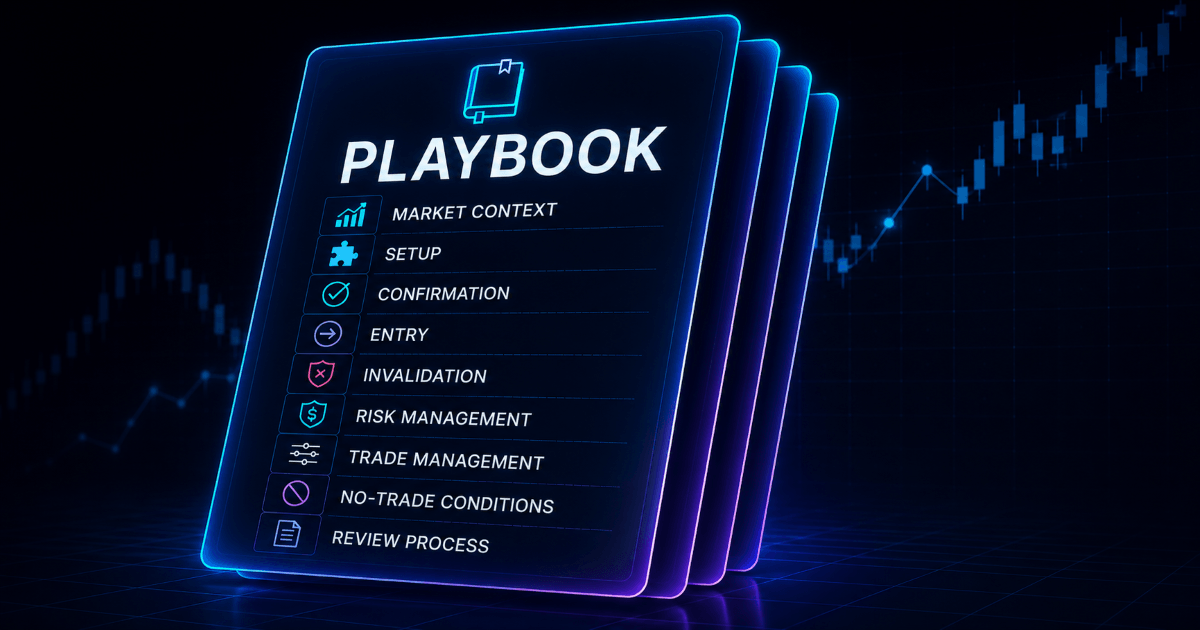
You probably already have a trading strategy. The problem is what happens after the market opens.
You enter too early, move your stop, or take trades outside your plan. Sound familiar? Your strategy may not be the problem. It may simply exist in your head. A trading playbook turns your strategy into a process – what to look for, when to enter, when to stay out, and how to manage risk.
In this guide, you'll learn what a trading playbook is and the easiest way to build one.
What Is a Trading Playbook?
A trading playbook is a structured collection of trading setups, rules, conditions, and risk parameters that tells you how to respond to specific market situations.
Think of it as your operating manual for trading. Your strategy might say: "I trade breakouts." Your playbook answers: Which breakouts? In what market conditions? What confirms the setup? Where do you enter? And so forth. That's the difference.
Your strategy tells you what you trade. Your playbook tells you how you trade it.
A good trading playbook takes decisions that are easy to change under pressure and defines them before you're under pressure.
What Should Your Trading Playbook Contain?
You don't need 50 rules. You need the rules that determine whether a trade actually qualifies.
1. Market Context
First, define the environment. Ask: When does this setup make sense? You might consider market trend or range, higher-timeframe structure, volatility, trading session, key support and resistance, market regime, and major scheduled events. The same setup can behave very differently in different conditions.
2. Setup Criteria
Define exactly what you're looking for. "Strong momentum" isn't a rule. It's an interpretation. If momentum matters to your strategy, define what it means. The more observable the condition, the easier it is to execute and review.
3. Confirmation
A setup isn't necessarily a trade. Define what needs to happen before the setup becomes actionable. That might involve price structure, volume, momentum, volatility, multiple-timeframe alignment, a specific price-action event.
Your exact confirmation depends on your strategy. The principle is universal: Know what you're waiting for before you're watching it happen.
4. Entry
Define the event that triggers your trade. You should be able to look at the chart afterward and answer: Did my entry condition actually happen? If you can't answer that clearly, your rule is probably too vague.
5. Invalidation
This is one of the most important parts of a trading playbook. Ask: What would prove my original thesis wrong? Your invalidation should connect to the logic behind your setup. Otherwise, it's easy to keep giving a losing trade "a little more room."
6. Risk
Decide your risk before you enter. Your playbook can define position-sizing rules, maximum risk per trade, maximum daily loss, maximum number of attempts, conditions that prevent you from trading. Don't let your risk change because you suddenly feel more confident.
7. Management
What happens after you enter? Define the decisions you're likely to face. For example, when can you adjust your stop? When should you reduce the position? What happens if the original setup changes? If discretion is part of your strategy, define where discretion is allowed.
8. No-Trade Conditions
This is where many traders stop too early. A playbook shouldn't only tell you when to trade. It should tell you when not to trade. No confirmation? No trade. Wrong market context? No trade. Risk doesn't fit? No trade. Setup is already too extended? No trade. Knowing when to do nothing is part of having a trading process.
9. Review
Finally, define what you'll review after the trade. Ask: Did the context qualify? Did the setup qualify? Was confirmation present? Did I follow the entry rule? Did I respect my risk? Did I follow the management rules? Did I break any rules? What should I learn? This is where your playbook becomes more than a checklist. It becomes a way to improve.
Benefits of Trading Playbooks
A trading playbook doesn't make the market predictable. It makes your process more predictable. That has several advantages.
1. You Make Fewer Decisions Under Pressure
You don't want to decide your entire trading process while watching your money move tick by tick. If you've already defined your setup, entry, invalidation, and risk, there are fewer decisions left to improvise. Decide before the pressure. That's the advantage.
2. You Reduce Emotional Improvisation
Trading can trigger a predictable sequence: You enter. Price drops. You move your stop. Price drops again. You tell yourself you'll give it "just a little more room." Now you're no longer managing the trade you originally planned. You're managing a new trade. A playbook gives you predefined boundaries. It doesn't remove emotion. It gives you something objective to follow when emotion shows up.
3. You Improve Risk Discipline
Your risk shouldn't be decided after you've fallen in love with a setup.
Before entering, you should already know:
- Where your thesis becomes invalid
- How much you're willing to risk
- How position size is calculated
- What conditions disqualify the trade
- What happens if the trade moves against you
You aren't eliminating risk. You're defining your response to it.
4. You Can Separate Process from Outcome
This is critical. A good trade can lose money. A bad trade can make money. If you break every rule and make a profit, the outcome doesn't prove the process was good. If you follow your rules perfectly and lose, the outcome doesn't automatically prove the process was bad.
5. You Can Find Patterns in Your Trading
Imagine reviewing 50 trades. Without structure, you might see 24 winners and 26 losers. But why? With defined playbooks, you can start asking: Which setup performs best? Which market conditions produce the weakest trades? Where are you entering too early?
Now your trading history becomes a source of information. You can improve what you can actually identify.
6. Your Playbook Gets Better with Experience
Your first version might not be perfect. You trade it. You review it. You find weaknesses. You refine it.
For example, you may discover that a breakout setup behaves differently when volatility is unusually high, when the market is ranging, or when price has already tested the same level multiple times. Those observations can lead to better filters and clearer rules.
Build Your Trading Playbook With TensorAlgo
TensorAlgo is designed to turn your trading logic into structured Playbooks.
You can start with a ready-made Playbook, use AI-assisted creation to structure your ideas, or build a custom Playbook around your own trading methodology.
Once your process is structured, you can review it, identify weak points, clarify vague rules, and improve the workflow over time.