

Trading Automation Explained
Trading automation is an end-to-end state machine, not just an entry signal. Follow the path from fresh market data through strategy and risk to order intent, execution, reconciliation, monitoring and safe recovery.
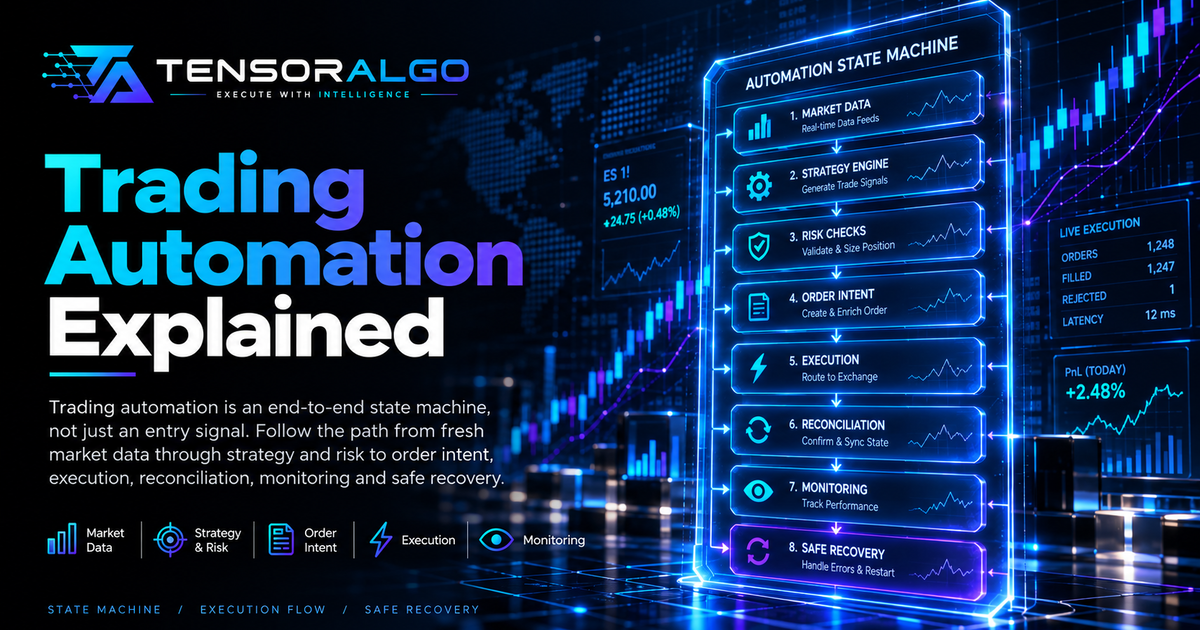
Trading Automation Explained: From Market Data to Safe Execution
Trading automation is more than sending an order when an indicator changes. A production system must keep market data, strategy state, risk, orders, broker state, and recovery logic synchronized.
Educational information only. Automated futures trading involves market and operational risk.
The automation pipeline
A robust system can be viewed as:
data → normalization → context → strategy → risk → order intent → execution → reconciliation → monitoring
Every boundary can fail, so every boundary needs an explicit contract.
Data must be fresh
Before a strategy acts, verify that required feeds are present, timestamped, and within freshness limits. Missing data should normally produce an abstention rather than a fabricated value.
Fallback providers can improve resilience, but they should not silently mix incompatible definitions.
Separate analysis from execution
An analysis can say a setup is eligible without creating an order. Keeping these layers separate allows risk checks, user controls, and operational guards to intervene.
Use explicit states such as inactive, armed, triggered, in-trade, closed, and cancelled.
Idempotency prevents duplicate actions
Networks retry. Webhooks arrive twice. Workers restart. A trading system must make repeated delivery of the same event safe.
Assign stable identifiers to plans/orders and ensure a retry cannot create a second unintended position.
State transitions need guards
A delayed heartbeat should never revive a cancelled setup. Writes should include expected-state conditions so stale requests cannot overwrite newer authoritative state.
This is one of the most important differences between a demo script and resilient automation.
Risk checks before execution
Independent controls can enforce:
- permitted instruments;
- maximum quantity;
- session limits;
- daily loss limits;
- event restrictions;
- data freshness;
- duplicate prevention;
- current position state.
Strategy confidence should not bypass these controls.
Broker reconciliation
Your database is not necessarily the broker's truth. After reconnects or ambiguous responses, reconcile open orders and positions before sending new orders.
Unknown state should fail closed until resolved.
Partial fills and order lifecycle
An order is not simply “sent” or “done.” Systems need to handle acknowledgements, partial fills, cancels, rejects, replacements, and race conditions.
The strategy state should follow confirmed execution rather than assuming a requested action occurred.
Kill switches and degradation
Provide a way to disable new execution without destroying observability. A degraded system may continue collecting data and reporting status while refusing new orders.
Failing safely is a feature.
Observability
Log the inputs and decisions required to reconstruct what happened:
- data timestamps;
- strategy version;
- state transition;
- risk decision;
- order intent;
- broker acknowledgement/fill;
- retries/errors;
- reconciliation outcome.
Alerts should be actionable rather than noisy.
Testing automation
Test at multiple levels:
- deterministic unit tests;
- historical simulation;
- integration tests with failure injection;
- shadow operation on live data;
- simulated execution;
- tightly controlled production rollout.
Test disconnects, duplicate messages, stale data, out-of-order events, restarts, and broker uncertainty—not only the happy path.
Human controls
Automation can reduce repetitive actions without eliminating human responsibility. Make current state visible, provide explicit disable/close controls where appropriate, and avoid interfaces that hide uncertainty.
Levels of Automation
Automation exists on a spectrum: alerts only; automated analysis with manual execution; semi-automated order preparation; deterministic execution; and highly autonomous systems. Moving right increases the need for independent risk controls, reconciliation, permissions, observability and failure recovery.
The Order State Machine
Treat order state explicitly: intent → submitted → acknowledged → partially filled/filled → cancelled/rejected. Strategy state and broker state are related but not identical. A strategy should not mark itself in-trade merely because an order request was sent.
Idempotency Example
Suppose a webhook times out after the broker accepted an order. The sender retries. Without a stable event/order key, the retry can create a duplicate. Idempotent handling stores the key and returns the existing result rather than performing the action twice.
Optimistic Concurrency
Delayed requests can overwrite newer state. Guard writes with an expected current state/version. A cancellation should not be changed back to pending by an older heartbeat that arrives later. This pattern is important anywhere distributed components update the same trade lifecycle.
Reconciliation
After reconnect or ambiguous acknowledgement, compare local open orders/positions with the authoritative execution venue before sending anything new. Unknown position state should normally block new automated exposure until resolved.
Failure Injection
Test more than the happy path: stale data, duplicate webhooks, out-of-order events, API timeout after success, partial fills, rejected cancels, process restart, network partition and clock skew. A system that only works when every dependency responds perfectly is not production-ready.
Pre-Trade Risk Controls
The CME Globex Credit Controls illustrate the broader principle of pre-execution controls in electronic markets. Your own system can independently enforce allowed instruments, maximum quantity, open risk, data freshness and kill-switch state before an order intent becomes executable.
Observability and SLOs
Measure feed age, decision latency, order acknowledgement time, retry count, reconciliation failures and state-transition errors. Alerts should identify a condition requiring action rather than merely report every transient retry.
Security and Permissions
Use least-privilege credentials, keep secrets server-side, rotate keys, separate read-only analytics from execution permissions and log consequential actions. An AI or user-interface layer should not possess more authority than it needs.
From Playbook to Automation
Start with Rule-Based Trading and Risk Management before automating. TensorAlgo currently positions Playbooks as user-defined workflow and monitoring tools rather than a brokerage execution service; current product details are documented in the Support Center.
TensorAlgo in an Automated Workflow
TensorAlgo can structure user-defined Playbooks, supported market context and trade-review evidence alongside a trader's execution stack. Automation should still keep broker state, permissions and risk controls authoritative outside any analytical or AI layer. The Support Center documents current TensorAlgo capabilities and boundaries.
Event-Driven Architecture
Represent market updates, strategy transitions and execution acknowledgements as events with stable IDs and timestamps. Consumers should tolerate duplicates and out-of-order delivery. Event logs make incidents reconstructable.
Authoritative State
Decide which system owns market state, strategy state, order state and position state. The broker or execution venue is authoritative for actual orders/positions; local databases are projections that must reconcile.
Exactly-Once Is Usually an Illusion
Distributed systems commonly provide at-least-once delivery. Design effects to be idempotent instead of assuming a message can never repeat. Stable keys and transactional state guards are core execution protections.
Timeouts Are Ambiguous
A timeout means the response was not observed, not necessarily that the action failed. Query authoritative state before retrying a consequential action. Blind retry is a classic path to duplicate orders.
Stale Data
Attach freshness thresholds to every required feed. A last-known price can look plausible long after a feed dies. Display stale state visibly and fail closed when a strategy requires fresh information.
Clock Discipline
Use consistent timestamps and synchronize clocks. Session rules, economic events and order sequencing can fail when systems disagree about time. Store UTC internally and convert explicitly for user-facing sessions.
Rate Limits and Backpressure
Bound retry frequency, use exponential backoff where appropriate and prioritize critical execution/reconciliation traffic over nonessential analytics. An outage should not trigger a retry storm that creates a second outage.
Deployment Safety
Use staged releases, health checks, rollback and version identifiers in logs. Never deploy a strategy-state change without being able to tell which version produced a live decision.
Incident Response
Define who/what disables new entries, how open positions are verified, where logs are collected and how recovery is proven. Afterward, write a timeline and corrective action rather than relying on memory.
Simulation Boundaries
Paper environments may not reproduce queue position, partial fills or disconnect behavior. Test infrastructure failures separately from strategy backtests.
AI Boundaries
If AI proposes actions, deterministic software should validate instrument, quantity, state, risk and permission. The model can assist decision-making without becoming the sole execution safety layer.
Related Guides
Start with Rule-Based Trading and Risk Management, then use Forward Testing before increasing automation influence.
Order Intent Versus Order
An order intent is what the strategy wants; an acknowledged order is what the execution venue accepted. Persist both. This distinction makes retries and incident analysis far clearer than a single boolean such as ordered\=true.
Partial Fill Example
A three-contract order fills one contract and then the remainder is cancelled. Strategy management must know actual quantity, average fill and remaining orders. Assuming the requested quantity filled can create an incorrect stop or an unintended later order.
Recovery After Restart
On startup, do not trust in-memory state. Load persisted strategy state, query authoritative orders/positions, reconcile differences and only then enable new actions. Startup is a high-risk state transition.
Kill Switch Design
A kill switch should stop new automated exposure predictably while preserving enough monitoring to understand existing state. Define whether it cancels working orders, closes positions or only blocks new intents; those are materially different actions.
Audit Trail
For every consequential transition store event ID, previous/new state, timestamp, strategy version, reason and actor/system component. An audit trail should answer what happened without reconstructing the story from scattered console logs.
Production Readiness Checklist
Before enabling execution, prove data freshness guards, duplicate protection, state guards, reconciliation, maximum quantity/risk, restart recovery, alerting, kill switch and rollback. Strategy quality cannot compensate for broken execution plumbing.
Design Around Authoritative State
The hardest automation failures often happen when two systems disagree about what is true. A local process may think an order timed out while the broker accepted it; a reconnect may replay an event; a partial fill may leave the position between expected states. The automation therefore needs an explicit source of authority for orders and positions and a reconciliation path whenever certainty is lost.
Model order intent separately from confirmed order state. Give each intent a durable identifier so retries do not create duplicate exposure. Idempotency does not mean “send once”; it means repeated processing of the same intent cannot accidentally create a second logical action.
The Rule-Based Trading guide covers deterministic decision logic, while Building a Professional Trading Workflow shows how the same separation of qualification, execution and reconciliation helps manual workflows.
A Minimal State Machine
A simplified lifecycle might be candidate → eligible → armed → order-intent → acknowledged → partially-filled/filled → managed → exiting → flat, with explicit cancelled, rejected and error states. Define which transitions are legal and what evidence authorizes each one.
Timeout is not a state of the market. If an API request times out, the correct response is usually to query authoritative state before retrying rather than assuming failure.
Independent Risk Controls
Risk controls should be able to block new actions even if the strategy engine is malfunctioning. Useful layers include maximum quantity, exposure limits, stale-data guards, daily loss boundaries and a kill path. CME Group's current risk-management documentation describes institutional examples including pre-execution exposure/quantity limits, order blocking and a Globex Kill Switch that can block new order entry and cancel working orders. Your implementation will differ, but the architectural principle is the same: risk should not depend on the same component that creates the order.
See the Risk Management Guide for trader-level risk and the Position Sizing Guide for contract sizing.
Observe the System, Not Just the Trades
Monitor data age, event-loop/processing latency, rejected orders, duplicate intents, reconciliation mismatches, reconnects and heartbeat failures. A strategy can be statistically sound while its runtime is unsafe.
Keep structured logs with correlation IDs across signal, risk decision, order intent and broker response. That makes post-incident reconstruction possible and supports the Trading Journal Guide when technical incidents need to be separated from strategy outcomes.
Test Failure Paths Deliberately
Before production, simulate stale data, dropped acknowledgements, duplicate events, partial fills, restarts and unavailable dependencies. The Forward Testing Guide provides a staged path from shadow to constrained production influence.
Primary references: CME pre-trade risk management documents exchange-side controls, and CME's Risk Management Tools documents credit controls, RMI and kill-switch functionality. These are examples of production risk architecture, not guarantees that any specific retail automation is safe.
Deployment and Change Safety
Treat trading automation like production software. Use versioned releases, tests, staged deployment and an explicit rollback path. A strategy change and an infrastructure change should be distinguishable in logs so a performance shift can be attributed correctly.
Deployments should not silently reset state. On restart, the system should rebuild or reconcile open orders, positions, active risk limits and strategy state from authoritative sources before accepting new actions.
Rate limits and backpressure
External APIs can slow down or reject requests. Queue work deliberately, cap retries and avoid retry storms. If fresh market state cannot be processed within the strategy's latency assumptions, fail closed for new exposure rather than acting on stale information.
Clock discipline
Store timestamps with clear timezone/offset semantics and synchronize system clocks. Session boundaries, economic events and contract-roll logic can all fail when local-time assumptions drift.
Incident review
After an operational incident, reconstruct the timeline from correlated logs: input data, strategy decision, risk result, order intent, broker response and reconciliation. Fix the systemic cause rather than only the visible symptom.
Automation quality is measured as much by how safely it handles ambiguity and failure as by how quickly it sends a valid order.
Frequently Asked Questions
What should be automated first?
Start with repetitive, well-defined tasks whose inputs, outputs and failure behavior are clear. Ambiguous strategy logic becomes harder—not safer—when automated.
What does idempotency mean in trading automation?
It means a retried event should not accidentally create a second order or duplicate state transition. Each intent needs a stable identity and guarded processing.
Why is broker reconciliation necessary?
The broker or execution venue is authoritative for actual order and position state. Local software must compare its assumptions with that external state after reconnects, partial fills and failures.
Does an automated trading system need a kill switch?
A production system should have a deterministic way to stop new actions and enter a safe state when data, connectivity, permissions or position state cannot be trusted.
Final Takeaway
Reliable automation is a state-management and risk-control problem as much as a strategy problem. Make data freshness, order intent, idempotency, broker reconciliation, failure handling and rollback explicit before increasing autonomy.