

Understand sample size and reliability
Trade Intelligence Center is designed to help you distinguish an interesting result from evidence that deserves more confidence.
A 70% win rate from a handful of completed trades and a similar win rate from a much larger sample are not the same statement. Sample-size and evidence guidance exists so you do not have to pretend they are.
Read every conclusion together with the evidence behind it
When TensorAlgo highlights a Playbook, strategy, session, execution issue, or downside pattern, look at more than the headline result.
Also consider:
- completed-trade count;
- average R as well as total R;
- win rate where relevant;
- whether one outlier dominates the result;
- whether the evidence is concentrated in one session;
- whether the same observation persists in a later sample.
This is especially important before changing a Playbook you own.
Small samples are useful—just not conclusive
A small sample can still tell you what to watch. The mistake is treating an early observation as a settled edge or weakness.
Depending on the sample and section, TensorAlgo can describe evidence as limited, developing, an early indication, or more strongly supported. Use that label as part of the conclusion, not as decoration underneath it.
Low-sample states protect you from false certainty
When there are not enough completed trades for a strong deterministic highlight, Trade Intelligence Center can show a low-sample state instead of forcing a confident conclusion.
That is useful information. It tells you that the best next action may be collect more evidence, not immediately change the strategy.
You can sometimes broaden the period when that makes sense, but do not broaden it merely to manufacture a larger number. The larger period should still match the behavior you are trying to understand.
Full AI reviews use the same evidence-awareness
A Complete Performance Review can combine Playbook, strategy, session, execution, downside, and performance evidence into a written synthesis. The report should still distinguish stronger evidence from observations that need more data.
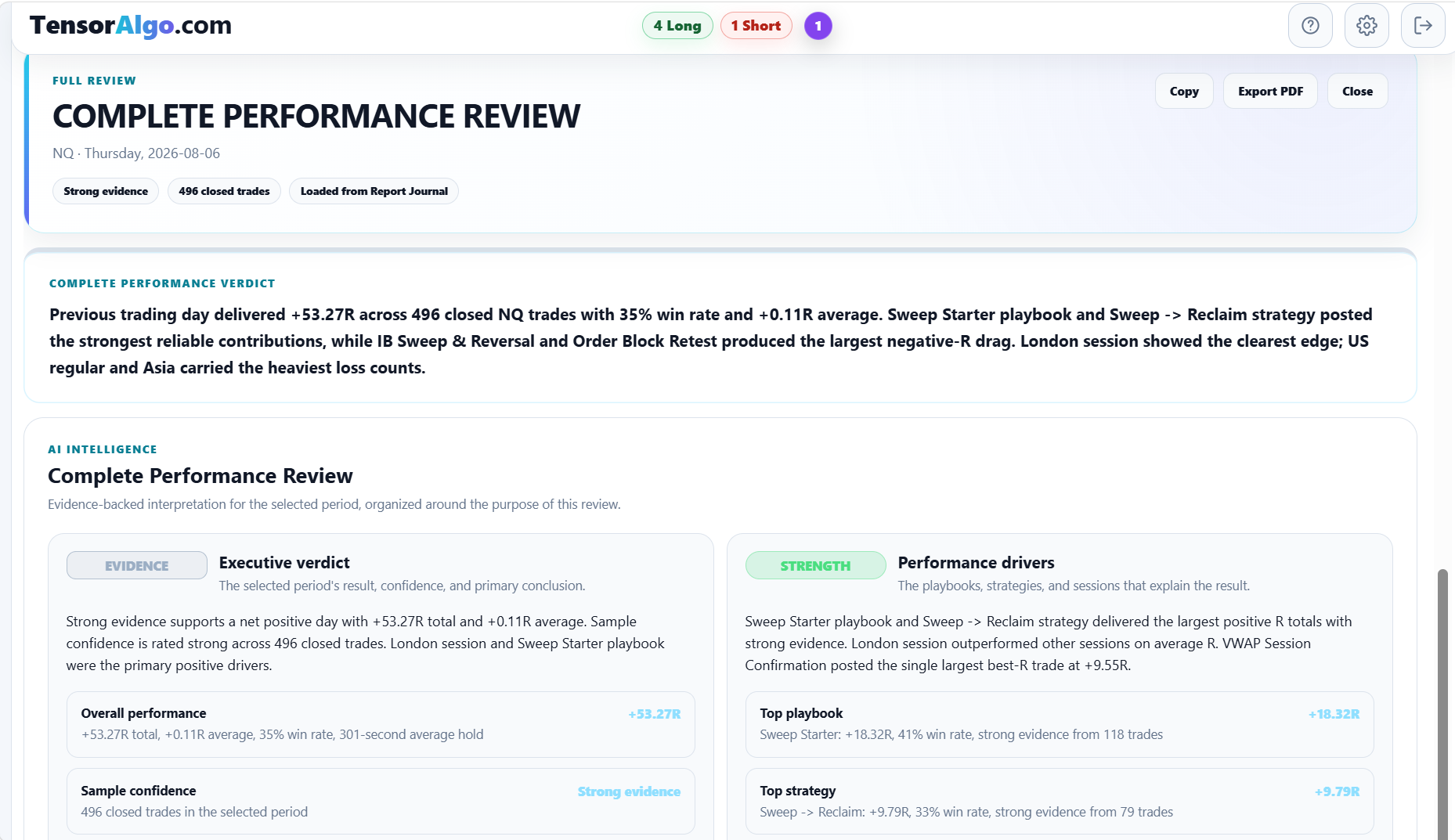
AI does not remove the need to understand the sample. It helps organize the evidence that exists.
Watch for concentration and outliers
A large total result can come from broad consistency or from one exceptional trade. Those are different situations.
When a contributor stands out, check Trade History and ask:
- How many completed trades produced this result?
- Is the average result still strong without the biggest outlier?
- Did most of the result happen in one session?
- Is the same strategy producing both the largest wins and largest downside?
The goal is not to eliminate outliers from the record. It is to understand whether the conclusion depends on them.
Empty sample versus small sample
These states require different responses:
- Empty sample: no eligible completed trades match the selected instrument and period. Check the scope, filters, historical-data range, and Trade History.
- Small sample: completed trades exist, but the evidence is still limited. Keep the observation provisional and continue collecting data.
If a sample should not be empty, use the Trade Intelligence troubleshooting guide. If it is simply small, no technical fix is required.
Use saved reports to test whether an observation survives
The Report Journal makes sample-awareness more practical because you can compare an earlier report with a later one.
A useful question is: Did the conclusion become stronger, weaker, or disappear after more completed trades?
That is more informative than judging whether the newest report agrees with what you hoped to see.